Curiosity ~ Lucidity ~ Humanity

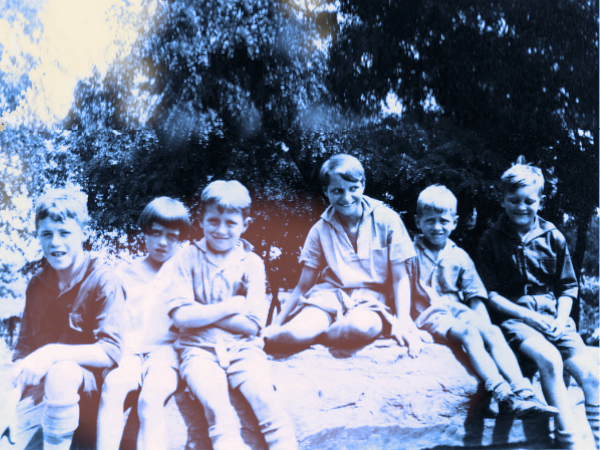
Author's note: "Uncle Arthur is the boy furthest to the right. I believe that this is the only picture in existence of my Uncle Arthur. It is the only one of my father (the boy in front with his arms crossed) and my aunts and uncles together. It was taken around 1930 at the Wartburg Orphanage where they were housed for almost 9 years."
Gowanda, aka The Nuthouse, was a New York State psychiatric hospital. Fittingly enough, it’s now a New York State prison.
“It was a dark and stormy night.” At least that’s how family tragedies are supposed to begin. Except it wasn’t dark, it wasn’t stormy, and it wasn’t night. The truth is it was probably just another gray Buffalo morning with my father smoking in the car and my Uncle Chuck there to help.
What were we doing? After 10 years of being at Gowanda, my dad’s brother, Art, was being released. I didn’t understand what they were talking about in the front seat. And I kept asking, but they’d say, in typical dad fashion, “Not now, Tommy.” Dad kept calling it “the nuthouse.”
He blurted out, “What the fuck do these people think they’re doing? Do they think that there are people out there who will be taking care of his fucking needs?” That was my father. That was the first time I had heard him say that word, so I knew he was troubled.
“Jesus Christ, I’ve not seen him in over 10 years. Maybe more.”
Uncle Chuck said to my dad, “Wally, what are you going to do with him?”
My father didn’t answer right away. He just kept lighting one smoke off the other. Dad smoked a lot, but this was ridiculous and I knew not to ask if we could roll the windows down.
“I’ve got his Social Security checks coming to my house, I’ve got a bank account in his name and deposit slips for his checks, and I’ve set up a bed at the City Mission downtown.”
I heard Chuck grunt and he must have given some kind of look.
He followed up with, “Yeah, Chuck, the city fucking mission. What else could I do? My father just died and you have no idea how much Art hated The Stepmother.”
Chuck was my mom’s brother-in-law, married to her oldest sister, Alice. He was the guy we turned to when there was trouble. He was inner-city tough. Irish projects tough. The guy who would either end up in jail or as a cop. He was a cop. He was a gold-shield detective. All I knew about him then was that you couldn’t talk at his house on Sundays because that’s when golf was on and Arnie and Jack were lighting it up. And there was a picture of him all muscle and bursting from his cop uniform on his cop motorcycle. That was before he was the good-natured devout Catholic guy with the great dad jokes or as my mom would say, “that was before he became St. Charles of Lake View.”
This job just fell onto Wally, who must have been on the list to call and he answered. Would any of the other Tilert kids as adults even let Art in the house? My mom did. Wally did. Al didn’t, his wife Rita didn’t. Ev? I don’t think so. Dorothea? Not sure. Bill couldn’t—he’d had his stroke ten years earlier and Lillian was the only one who could understand a word he said. This was 1966, the same year my grandfather John died. Everyone in that family was dealing with something.
We rolled up on the nuthouse. I seriously thought it was a Planter’s factory, but it sure wasn’t that. It looked like a prison. It was huge. The grounds alone could’ve housed another dozen exact replica nuthouses.
“Dad. Dad. What’s a nuthouse?”
“Not now, Tommy.”
I was frightened. I had no clue what was going on, but it was serious. Wally and Chuck snapping at me, the hushed tones, the f-bombs, even the shitty Buffalo weather added to what was going on in my stomach. I didn’t feel like throwing up, it was more like I had 10 final exams in one day.
My dad got out of the car and went to the entrance of the facility. Chuck said, “Come up to the front seat, Tommy. You’re going to ride up front with your dad. I’ll be in the back with your Uncle.”
I was standing outside the car when I first saw my Uncle Art. He was like my father’s twin brother. Only he looked a little wobbly. I asked Chuck what was wrong, but Chuck told me to hush.
Art brushed past me and didn’t say anything at all. Dad was gentle in helping him get into the back seat with Chuck. My father admonished me, “Be quiet and don’t stare.” I decided to investigate the cigarette burns on the seat.
I didn’t understand what was happening then and I still don’t now. In the years since, I’ve tried to piece some things together—like my parents’ relationship with their siblings. Especially on Wally’s side.
In the big picture book of my parents’ wedding, there are my parents, of course, both sets of grandparents, my Aunt Esther (mom’s sister), and my dad’s friend, Peter Dobrowski, aka Petey Goddammit. I could see some others in the picture, like my Aunt Alice (my mom’s other sister).
Here’s who I don’t remember seeing. My father’s siblings. Not the sisters, Dorothea or Evelyn. Not his brother Bill, not his younger brother Al, and definitely not Art.
The wedding ceremony was that small because Wally was Lutheran. They had to get married in the rectory of our church, and it was small.
Why not Art?
Art’s young wife, Frances, had been admitted to the Tuberculosis ward at the Edward J. Meyer Memorial Hospital, what is now known as the Erie County Medical Center (ECMC) near downtown Buffalo.
TB was a deadly disease, and it was one of those diseases like AIDS in the 90s—there was some sort of stigma attached.
I don’t know if Wally asked him to be in his wedding and was told, “I can’t, Wally, not with Frances like this.” Or if Wally didn’t ask him to be in the wedding because he didn’t want to burden Art when his wife was dying of consumption. Frances was in that ward for 2 years. Art was with her every day.
Here’s the thing that still gets me. The same man who sat with his dying wife every day for two years, no exceptions, was also the man his own family had decided needed his money managed by someone else and his mail sent to a different address. Nobody who watched him with Frances for those two years would have called him unreliable. But that’s exactly what the rest of his life had already convinced everyone he was.
After Frances passed away, he tried to get his life in order. However, he was rejected for a job at the steel plant, when they’d hire anyone who walked through the employment door. Even the Jehovah’s Witnesses told him no.
About the time I came around in 1956, he was arrested. He took off all his clothes and was standing outside the massive plant along the shores of Lake Erie yelling “Fuck you, Bethlehem Steel.” I’m sure the good factory folks in Lackawanna were horrified and immediately called the police. Art was subsequently committed to Gowanda.
I didn’t know any of this then.
Wally lit up another smoke, which Art waved away from the back seat. I giggled and then tried to cover it up with a cough. We settled in.
Nobody said anything on the way to the City Mission where Art was going to live. It was the first and only time I had seen the City Mission—it wasn’t the type of place kids would go visit and Art had a bed there. That was it.
Art was at his new home. We resumed our positions on the way to Chuck’s house. Wally and Chuck were in the front seat and I was in the back. Chuck shut his eyes and feigned sleep while Wally drove.
My Uncle Art showed up at our house one summer day in his winter coat with his whole left hand bandaged. I must have been around 11 years old. I noticed that he had long hair, a long beard, and his hands were dirty again. The thing I wondered the most was: how did he get that coat on over all that gauze?
My father, Wally, asked, “Jesus, Art, what happened?” “I got a job at the bread company. I was working on the slicing machine. There was an accident and I sliced off two of my fingers.”
“Are you all right?”
“Yeah. It hurts but it’s getting better. They gave me medicine. I don’t like to take it.”
“Are you taking your other medicine?”
“Yes, Walter, when I remember and when I’m sleeping at the Mission.”
“We talked about that, didn’t we?”
“Yes. It’s too loud there and I feel like I’m back in the hospital.”
“Are they taking care of you?”
“Yeah, I have to go once a week to the hospital and they change the bandage and clean everything. Really, I’m OK.”
“If you say so, Art.”
I don’t think either of them thought he was OK.
Art was a multi-instrumentalist whose talent was essentially cut off with his fingers in the slicing accident. He was no longer able to play the clarinet or the tenor. He could play the harmonica, though. He didn’t need all his fingers for that.
Clarinets were big in the 30s and 40s because of Benny Goodman and His Orchestra. Benny Goodman was the King of Swing and Art got that kind of reputation before and after the war. Art played in bands in and around the Buffalo area. It was how he earned his money, while his two brothers served in the Army during the war. I don’t know why Art was 4F, I just know he was because of the stories Wally and Al told and because I can’t find any record of it.
As a kid, he was one of the kindest men I knew. He didn’t drink because of the religion that rejected him. He hated cigarettes. He was a good man.
Dad would say he could pick up any wind instrument and make it sing.
The year he was committed to the state hospital, it was all Elvis all the time. By the time he was released it was at the height of Beatlemania. Big band music was passé. I never heard him on the licorice stick or the sax, but I did hear him on the harmonica. He wasn’t Blues Traveler frontman John Popper, but he could carry a tune. It was fun hearing him play.
Wally didn’t know who took care of all the Workers’ Comp paperwork, but Art got a big settlement. My father recovered some of this money and put it in his bank. This was after the big spending spree and distribution of his gifts to his buddies.
Art bought harmonicas with the bulk of the settlement. I got one of the harmonicas—it was a really nice one. It was long, maybe 12 inches, nice shiny metal, with M. Hohner emblazoned in the chrome on the top of it. It had one of those things on the side that Stevie Wonder would use. I never even got it out of the box before Wally snatched it from me.
“Where did you get this?”
“I got it from Uncle Art.”
“Not you—him.” He pointed to Art.
“I got it at the music store downtown on Main Street.”
“This isn’t a cheap one.”
“I know. I spent a lot of money on them.”
“On them? How many did you buy?”
“A few.”
“A few? How many?”
“A bunch.”
“Goddammit, Art, how many did you buy?”
“Probably a dozen.”
“And where are they?”
“I gave them to my friends. They’re my friends. It was my money. I can do whatever I want.”
Wally spent a few weeks in and around the Mission talking to Art’s friends. It didn’t go well. The pawn shops were even less help. They got the harmonicas, the friends got paid, and the local liquor stores got an economic boost.
We found out that not only did Art buy harmonicas, but he also bought color TVs. He didn’t buy many of them, but he did pass them out to his buddies. Wally didn’t recover any of them at all. I know we still watched Bugs Bunny on the 13-inch black and white in the living room.
My father was mad at Art for squandering his well-deserved money, but at the end of the day, Art was right. It was his money and he could do whatever he wanted with it.
“Mom, someone’s at the door, asking for you.”
“Who is it?”
“I don’t know, he looks like Howard Hughes.”
My mom came to the door and said, “Hello, Arthur. Wally’s not home right now.” She was usually warmer than this. “Let me call for him. He was at a neighbor’s doing something.”
“OK. Thanks, Alma.”
“Tommy, take your uncle outside by the picnic table to wait for your dad.”
I knew not to argue. I hadn’t seen him at the house in a long time and never this bad.
“Hi, Uncle Art,” I said, reaching my hand out to shake his. “I’m Tommy.”
He extended his dirty hand, with his untrimmed fingernails, took mine, and he said, “Hi, I’m your Uncle Art.”
“I know. We kind of met before—the first time was the day you were let out of the hospital.” I refrained from calling it the nuthouse.
He drifted off somewhere. He was clear-minded at times, like knowing that he was at Wally’s house and that my mom was Alma. I could hear her on the phone and it wasn’t pretty.
“Yeah, Dick, I know he’s busy. I need him home right now. None of your business. Just put him on the phone. Now. GODDAMMIT.” I knew if my mom was saying the GD word, it wasn’t good.
Dad spent a lot of time at Dick’s. It was a neighborhood bar and Dick had roped my father into fixing up the upstairs so that the bar could host stag nights before heading across the border for the Canadian ballet.
My mom continued, “Art’s here. Here. At the house. How the hell do I know? All I know is that you had better get home here right now. Dick’s shit can wait.”
Arthur snapped out of it, quietly, and asked me, “So how old are you?”
“I’m 16. Going into my senior year.”
“Wow. That’s young for senior year, isn’t it?”
“Yeah, the cutoff for school was December. My birthday’s in November, so I was an early starter.”
“Oh yeah? My birthday’s in November, too. I didn’t get to go to high school much. I had to work in the factory.”
“Was this at the spring factory where your father was?”
“Yeah. I left soon after that.”
“Where did you go?”
“Oh. Here and there. I don’t remember. My brother, Al, went to Maryland.” Then he drifted away again.
Just then my father came home, smelling of beer and cigarettes. He was working, so he hadn’t hit the vodka yet.
“Hey, Art.”
“Hey, Wally.”
“What are you doing here?”
“I came for the dictionary.”
“What? What dictionary?”
“You know what dictionary, Wally. The one our father got me for my birthday. The unabridged one.”
“Let’s not do this again, Art. I can’t let you take the dictionary.”
“But it’s mine.”
“Yeah, Art, I know that, but I can’t let you take it. We’ve been through this before.”
I knew the dictionary. It was enormous—it was about 3,000 pages and weighed about 20 pounds. It was Arthur’s, but there was no way my dad was going to let him take it to the City Mission or wherever Art was going to be. On good nights he slept at the Mission. Other nights nobody knew where he slept. My mother occasionally ran into Art downtown at lunch. Her coworkers pretended not to notice.
“C’mon, Art, let’s get you cleaned up first, then we can move to talking about the dictionary.”
“Tommy, get the clippers while I help Art out of his jacket.”
The jacket that Art wore was an overcoat stuffed with matchbooks, scraps of paper, pencils and pens, anything that meant something to him. His shoes were about three sizes too big because his toenails hadn’t been trimmed in a long time. He wore two shirts and even though it was summertime in Buffalo, he had long johns on. After we peeled off his layers of clothes down to his skivvies, my father took the clippers and sheared off his wild beard and his scraggly hair. He was starting to look like the man we picked up at the hospital.
While my father got on his hands and knees to trim his toenails, I asked my uncle if I could get him a cup of coffee.
“Sure, if it’s no bother.”
“It’s not a bother; I was making one for myself. Cream and sugar?”
“Sure. How about a double-double?”
“Coming right up.”
We always had instant coffee in the house. I served my uncle and sat next to him at the kitchen table. We sat there, stirring our coffee, thinking of something to say.
“Looking good, Uncle Art.”
“Thanks, Tommy.”
My father was finishing up clipping his toenails. “Tommy, would you please start a bath for your uncle? And then sweep all this stuff up?”
“Sure, Dad.”
They disappeared into the bathroom. My mom came out with some of my father’s clothes—underwear, T-shirt, khaki pants and a flannel shirt—and a big garbage bag and told me to throw everything but his coat into the bag and put it with the rest of the garbage outside.
“Not his coat, Mom?”
“No. Not his coat. He’d be mad.”
Dad came out of the bathroom and took his clothes for Art to put on. My mom had some leftover roast beef and gravy in the freezer that I knew she was going to bring to work for one of her lunches. She put it on the stove for Art’s dinner.
She told me to take him outside because it was too nice a day to be stuck inside. My little sister, Margie, was at the picnic table with her crayons and coloring book.
Art saw her and said, “I love to color.”
“I do, too.”
“Can I show you something?”
“Sure.”
“Take the black crayon and draw the outlines before you color in the rest of the picture. It’ll keep you from going outside the lines. Here, let me show you.”
“Cool.”
He did just that. Then we watched as he cut in the colors inside the lines. Then Margie gave it a try. It took her a little longer, but soon her picture didn’t look like the others either.
“Thanks, Uncle Art.”
My mom called me in to pick up Art’s meal. Open-faced roast beef sandwich with horseradish and a homemade pickle.
“Please tell your mom thanks.”
She came out later, handed Art a few dollars, and said, “You better get going now, Art. The bus will be here any minute now.”
“OK, Alma, thanks a lot.”
My father brought out his coat, which he put on and we all walked him out to the driveway. He walked down the street, across the railroad tracks, and caught the number 15 bus downtown.
After Art left, Margie sat back down at the picnic table and opened her coloring book. Every picture she did started with the black outlines.
I feel more for the homeless because of my uncle than anything any pitch on TV would say. I see these folks on the streets every day.
Here’s the part I didn’t see until I wrote it down. My father cleaned him up, fed him, gave him cash, and put him back on the number 15 bus before dinner. My mother worried about having him around the kids all the time.
Nobody ever asked him to stay.
They loved him at a distance they’d already decided on, and I learned to do the same thing—care but keep it to an afternoon. I didn’t get my empathy in spite of how this family handled Art. I got it from watching exactly how they handled him: generously, and only for as long as the visit lasted.
But if you saw him when he was “off his meds” you’d see a man with a 6-month beard growth, long dirty hair, with his big winter coat in the middle of summer, stuffed with scraps of paper, talking to himself loudly.
You would cross the street.
When Art died, there was no church, no funeral home with his name on a sign out front. They buried him out of the Buffalo City Mission, which is about as plain as a send-off gets.
His daughter, Marie, called Aunt Dorothea. She let the one connective tissue of her family know that her father had died. Dorothea let the other Tilerts know about their brother.
Marie attended her father’s funeral. She must have gotten a phone number from one of my cousins, who picked Marie up and brought her downtown to the City Mission for the funeral.
Art’s pallbearers were his friends from the street—the men he used to hand harmonicas and color TVs to, the ones Wally thought he had no business spending money on. Nobody on our side of the family was so honored.
I have no clue what that cost her to come to her father’s funeral. I have an idea of what it’s like to attend your estranged father’s funeral.
I can’t imagine, though, Marie showing up to bury a father she’d been handed away from before she was old enough to remember having one. I don’t know if she cried, or stood in the back, or even if she said more than two words to anyone there.
I know she watched a room full of homeless men carry her father to his grave while his own relatives stood by, and that if there’s a single image in this whole family that tells you who Art was, it’s that one.
Bio-Fragment: Tom Tilert is a retiree, currently living in Costa Rica with his wife, Apryl, and two dogs, Hazel and Joy. Originally from Buffalo, New York, he joined the Army to make sure he never had to live through another blizzard.
He tends to be focused on one thing at a time and that focus now is on writing. He promised his wife that he was going to be 19.74% less obsessive this year and he’s tracking that progress on a daily basis. Things he obsesses about:
TV show characters holding coffee cups with no coffee in them.
Also, actors in movies with Russian accents that pronounce things incorrectly—things like ‘things.’ And Star Trek’s Chekov saying, ‘wodka’ instead of vodka.
Ten thousand steps a day.
Making up lyrics to songs that are wildly inappropriate.
He’s a member of the Bills Mafia, a membership he received through birth. This year his team has been putting him and the whole fan base through what can easily lead to cardiac failure. Each time the Bills play, he sits his family down and promises them that he will not overreact to how his team is playing. After he eventually does overreact, he puts himself in time out, which means the house is immaculate and all of the laundry is done.