Curiosity ~ Lucidity ~ Humanity

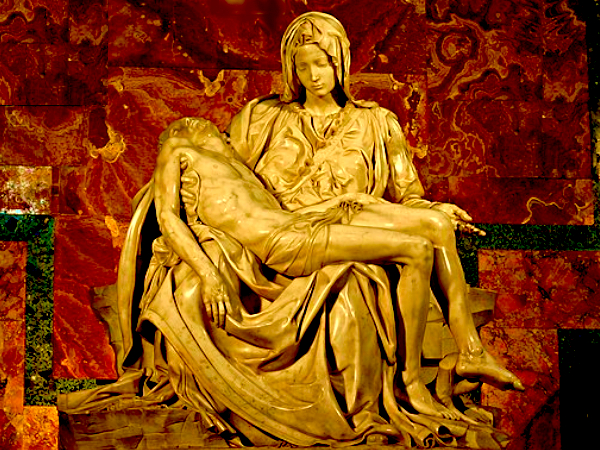
Original photograph by Stanislav Traykov
The work is nothing else than the long journeying through the labyrinth of art to find again
the two or three simple and great images upon which the heart first opened.
Camus
My parents weren't art connoisseurs nor were they culturally clueless. My mother owned a Peter, Paul and Mary LP. Occasionally she would pull out a boxed set of La Bohème records, a gift from her mother who had been to the opera many times. As a New Jersey teen, my mother had seen native son Frank Sinatra perform live. She said it looked like the TV clips of the Beatles — girls screaming and fainting.
In 1964 when I was eight years old, my parents took me to the New York World's Fair. Before my dawning eyes the future arrived thanks to AT&T, General Motors, and IBM.
The World's Fair was so remarkable that when it closed in Flushing Meadows Park, nobody had the heart to tear down the Unisphere, which stood proudly at the entrance. It's there today.
My father, who read the descriptions of each exposition to tell us what we were failing to see, insisted the most valuable exhibit at the Fair wasn't a rotating theater like the General Electric pavilion, but a statue. I wasn't in the habit of questioning my father. After all, did it make sense to disagree with someone who read four newspapers a day? In disbelief, we marched off to see Michelangelo's Pietà. I can't say I was bowled over by the sculpture, not being familiar with Christian iconography. I was impressed by its size, Mary as big as my father even though she was sitting down; and how did they carve folds into stone?
“It's nicely carved,” I told my father.
“That's not just any stone, Michael. It's marble.”
“So marble is expensive?”
“That's correct.”
“What's it worth?” I asked.
“The statue is priceless.”
That was an appraisal I'd never heard. “How much is priceless?”
“It's so valuable they can't put a price on it.”
From then on, anything I considered special was priceless. “This banana split supreme is priceless.”
The following summer, we returned for the second year of the World's Fair, and I insisted on another look at the priceless work. My Jewish mother held my hand as we gazed at the sculpture. “Look at the expression on her face,” my mother said. That's how much a mother loves her son.”
My father explained the statue had been shipped from Italy. Being an adolescent, I asked who was in charge of shipping it, and how could it be insured if it was priceless? My father didn't know, but he assured me, “Your questions are interesting. It's probably why they don't ship it often.”
A few days later, he returned from his newspaper office to inform me that Michelangelo, a contemporary of Christopher Columbus, had completed the Pietà in 1499. The NY World's Fair was the first time the statue had left Rome.
Now my wife and I travel to Italy every year to see her relatives. Inevitably we find our way to Rome, which still looks like the home of an empire. We visit the Vatican, where she hopes to catch a glimpse of the new Pope, and I stand motionless in front of La Pietà, its timeworn marble so venerable it brings a Jewish boy to tears.
Bio-Fragment: Michael Rubin is an expatriate living outside the US. He is retired, which offers him ample time to assemble his memories of childhood and connect them to Michelangelo and Saint Peter's Basilica.