Curiosity ~ Lucidity ~ Humanity

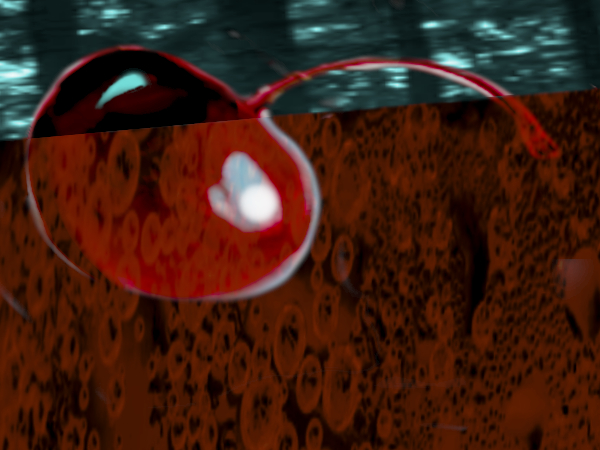
It’s hopeless if the cubes settle on the bottom of the glass. A straw can pierce a cherry only if there’s enough Coke left for the ice to float and the angle is exactly right.
Mine was a practiced hand.
Darrell slid into the booth next to Anthony and set down his buffet plate. “I made you a pope hat,” Samantha told him.
Crowned with the folded napkin, Darrell raised three fingers in benediction. “I bless thee, sausage gravy.” He asked me, “Do you like my pope hat, Adam?”
“It’s lovely.”
“Should I wear it to Long John Silver’s next Friday?” Darrell was an atheist, and my weekly Lenten pilgrimage provided mirth to all.
I found the joke less funny. “No.”
“Are you sure? The old Catholic ladies might like a pope to bless their fish.”
“Your holy sausage gravy is getting cold,” Anthony pointed out, so Darrell dug in. The gravy was another running joke. At a previous Eat’n Park midnight buffet, Darrell claimed that sausage gravy made all foods better. I asked if that included fried apple fritters. Ever after, he got apple fritters with gravy each time the waitress gave last call for the buffet, which means it must have been 2:00 am.
Eat’n Park was western Pennsylvanian Denny’s: when the bar had closed or you weren’t old enough for a bar, like us, it was open. Samantha had taught me that you could ask the waitresses for maraschino cherries in your cherry Coke. Whenever a cherry still had its stem, she would take it in her mouth and tie a knot with her tongue. We were all three in love with her.
“A pope would have to save a baby in a bucket,” I told Darrell.
His fork clapped to his plate as Anthony said, “Oh Jesus Christ.”
“Exactly,” I said. Samantha settled her grin on her hands to spectate. “This is why I need to be Pope. I’d clear all this up.” Darrell lofted his three-fingered blessing. “If thou seest a baby in a bucket, thou shalt have no obligation.”
“Pope Darrell, I regret to inform you,” I stated, “that Jesus would definitely say to pull the baby out of the bucket.”
“His mistake, not mine.”
“It’s not just Catholicism you’re shredding. It’s all morality.” I was one of the cool kids. “Love thy neighbor as thyself is the most basic fundamental there is.”
“No. Responsibility is.” Darrell was not vehement, not quite. “Is it my baby? Is it my bucket, or my water in the bucket? No. Loving your neighbor is great if you want to love your neighbor. Save all the babies you want, Adam Connolly. But I don’t have to love my neighbor. I definitely wouldn’t love a neighbor who’s too dumb to keep their baby out of a bucket.”
Samantha turned her head after each remark, tennis match style. Her lively eyes were now on me, waiting for me to return the volley, and I could feel her knee resting gently against mine.
“I’m going to the bathroom,” Anthony said.
Samantha’s hands made a time-out T.
“No, believe me, it’s OK,” Anthony said, but Samantha had called the pause. Darrell and I would respect it.
So Anthony was gone. I speared a cherry and another, and I tapped Samantha’s side to show her the two together on my straw: a pathetic courtship display, but what I had. She rewarded me with a brightly mimed golf clap. Darrell chewed his gravy-slathered fritters. All of which is to say, we were silent.
“How the hell can you eat?” demanded the woman in the next booth.
Her words sank into my Catholic stomach, which churned them into guilt with expert speed. Before I could apologize, though, I realized she didn’t mean us. That woman in the black Pantera shirt glared at her companion, whose back faced our booth. He had dark hair and a beard, from what I could see. I couldn’t tell if the woman was thirty or fifty. She had lived hard.
Her smoker’s voice slurred, “How can you eat?”
“Like this,” the man chewed.
“You heard Gary. Don’t act like you didn’t.”
“Gary’s a sick bastard,” the man said.
“So do something about it.”
“Like what?” he chewed.
“Some girl’s out there laying dead in a ditch somewhere, and you’re just going to sit there and eat? How the hell can you eat anything?”
“Hearsay. All hearsay.”
“Gary didn’t talk like hearsay.”
“He was drinking and running his mouth.”
“Some girl’s laying dead in a ditch out there!”
“Just running his mouth.”
“Gary could have done it.” She hit the table. “He’d do that. Don’t you know Gary could do that?”
“I don’t know,” the man muttered.
“Gary’s scary as hell. You know Gary could.”
“I said, I don’t fucking know.”
“Yeah you do. I do. I fucking do.”
“Is it over?” Anthony’s voice made me jump. As he slid into the booth, I kept peering between him and Darrell at the woman, staring at her unused silverware. “If you need more time to debate drowning babies, I can hitchhike home.”
Darrell waved Anthony off with a small gesture only our table could see. “What?” Anthony asked.
The woman restarted. “She could be somebody’s sister. Somebody’s daughter.”
“You don’t even know her name, so cut the shit. Gary was drinking and running his mouth.”
“Some girl’s body is rotting in the fucking woods, and you say—”
“You’re talking too loud,” the man told her.
Anthony’s eyes and jaw gaped. In the poker ring we co-ran in study hall, he owed an unprecedented $15; I was glad the woman could see only his back.
“You say he’s running his mouth,” the woman said, “but Gary’s scary as hell. He hits Sheila, you know he does, and God knows what he did to this poor woman.”
“Hearsay. Gary’s sick idea of a joke.”
“A woman dead in a ditch off Telegraph Road ain’t a goddamn joke.”
“Gary’s a sick crazy bastard, and I don’t know what he did do or didn’t do two years ago, but it ain’t my problem.”
The woman leaned in. “What kind of man are you?”
“Living,” he answered, “hungry as hell, and smart enough not to fuck with Gary, now shut the fuck up.”
Her forehead sank to her hands. She might have fallen asleep while the man finished eating; I didn’t see her move until he said, “Come on,” and they went to the register.
“Oh my God,” Anthony said.
The waitress stacked the departed man’s coffee cup on his plate and carried them to be washed. Then she wiped down the table, set fresh napkin-rolled silverware, and restocked the sugar packets.
“I need to go outside,” Samantha said.
I paid last. The night was cool but not cold, and I surveyed my friends, waiting between the two cars. Even now, I see that tableau more clearly than any other memory in my life. It exists beyond time. When I see my friends in that moment, I also see the time before and the time that followed. Everything is pressed into that memory.
Samantha stood with crossed arms, her dancer’s neck bent downward as she leaned against her Bonneville. In six months, we would kiss passionately in its backseat. She ended things after I told her I loved her. I had asked her to the homecoming dance once she turned down Anthony, and after it she kissed me goodnight on her porch with a softness and a warmth that neither my second kiss nor my thousandth would match.
Darrell leaned back against his white van, eyes skyward. He did that when he thought and probably still does. That battered van would carry his worldly possessions to college at summer’s end and back when he failed his first year. He worked construction with his dad. We saw less of each other.
Anthony sat on the concrete base of a light pole with folded hands. I see the light descending onto him in a perfect circle, but my memory added that later, I think. He fractured his neck and skull in a hiking accident on spring break, sophomore year.
Elbows on knees, Anthony spoke through his folded hands. “That happened, right?”
“Yeah.” Darrell still watched the sky, where through the streetlight we could see no stars. “This is so fucked,” Samantha said.
My head hadn’t fitted the pieces yet. It was Anthony who said, “We should call the police.”
No one got out a phone. I kept shuffling the pieces in my head, trying to work around the gaps.
“We call, right?” Anthony repeated.
“I don’t know what we’d say,” I said.
“We’d say what that woman said.”
“The cops won’t believe us. Nobody will. Fuck.” Samantha’s crossed arms tightened so she was holding herself. “Fuck, that poor woman.”
“What if we didn’t just call? What if we went in person?” I thought. “If we went, all four together—”
“There might not be a woman,” Darrell said.
“Yeah,” I said, “I know. I’m thinking.”
“Come on,” Anthony protested. “You all heard what she said. It sounded pretty darn bad to me.”
“It’s hearsay.” Darrell leveled his gaze, which meant he’d reached his conclusion. Although Anthony had just spoken, Darrell looked at me. “That guy in the booth knows way more than us, and he didn’t believe it.”
“Or he didn’t want to.”
“Either way. There might not be a woman.”
“There’s a woman,” Samantha said quietly.
I wanted to go to her. Anthony stood and rubbed her shoulder. I wanted to go to her, but I couldn’t. “I think there might be a woman,” I said, “but I can’t begin to prove it. I don’t know what we’d say.”
“We have a name,” Anthony insisted. “We have a timeframe. We have a location.”
“We have a first name,” Darrell said. “We have a rumor from a drunk. And Telegraph Road? My dad and I drive it to go hunting. It’s ten miles long. All of it’s wooded, on both sides.”
“There wasn’t anything else, from when I was in the bathroom?”
“No,” I confirmed. “That’s all they said. I’ve gone over it and over it. That’s all they said.”
“Fuck,” Samantha said.
I spoke to Darrell. “I still feel like we should do something.”
“It’s not about how you feel. None of our information is useful. Not to the police. Not to us.”
“Goodnight kids!” our waitress called from her car. “See you soon!”
I waved limply in the pre-dawn between the Bonneville and the van. Anthony probably did, too; Samantha didn’t move. Someone said we should go home. Samantha drove me, but we didn’t talk much. I said I was sorry, she said she knew, and that was the last any of us ever mentioned what we heard.
The four of us spent dozens of nights in that diner. I remember that one. The memory feels like nothing so much as original sin. There was no sin, not that I can confess, but it’s there. It’s part of me.
I check the news reports from Butler, Pennsylvania, each week. I didn’t always. I started a few years ago, waiting to hear of a body or a bone some hunter finds off Telegraph Road. If I read it, I’ll tell my wife I have to go home.
Darrell’s dad died but his mom and I mail each other Christmas cards. He’s in Virginia, I hear. I’ve lost touch of Samantha. I could find her somehow, or Darrell could, so we would come together in Eat’n Park: me, Samantha, Darrell, Anthony and other ghosts. Waitresses would bring Cokes with cherries we would fish out with straws. We would gather our memories and talk of what could be done.
Bio-Fragment: Ryan F. Love estimates he has read Daisy Miller 20 times with his high school classes. He’s learned a lot about writing by contemplating the same great sentences over and over and over; moreover, he figures if he eats a vaguely balanced diet, has a dog that likes him, and can get half a given group of sophomores to enjoy Henry James, he’s probably doing okay.