Curiosity ~ Lucidity ~ Humanity

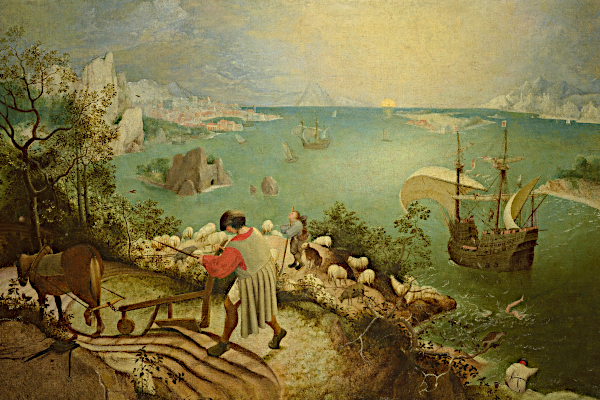
Pieter Bruegel the Elder, Landscape with the Fall of Icarus, c. 1560, Royal Museums of Fine Arts of Belgium, Brussels.
John took his morning coffee down the steep stairs into the basement, and stood staring at what had once been his home office. The desk was covered with piles of papers, some of which had fallen over and scattered on the floor. The floor space away from the desk was taken by a parapet of stacked cardboard boxes, some broken and spilling their contents. John had not looked, actually looked, at the collection in years, and now that he was studying it, the word scree came to mind.
A large box squatted on his office chair, holding a collection of coffee mugs, newspapers, notebooks, and a Davy Crocket coonskin cap. John lifted the box, arms underneath because it was breaking, and set it on top of a sturdy box that held the engine from the large-gauge Lionel train set John had inherited from his grandfather and never got around to setting up for the girls. He sat in the office chair, considering.
The youth, Thoreau said, gathers materials to build a bridge to the moon. In middle age, he uses those materials to build a woodshed. When John had explained that to Amy, she had raised an eyebrow and pointed out that middle-age was in sight, and how was the woodshed coming along?
That was years ago, and now they were about to celebrate their twentieth year together. For an anniversary gift, Amy had asked John if he would please please clean out the basement. She was nice about it, but she did point out that moving everything to the garage was not a solution, because that sorry, tumble-down structure was already so full of stuff that when you opened the door, stuff fell out. That was an exaggeration, but point taken.
Now Amy was off with the girls, helping Lizzie move into her dorm in the city. John stayed home, ostensibly to work at the newspaper office, but actually to do something about the stuff in the basement, as a surprise for Amy. That first morning after she and the girls left for the city, John cleared a space on the basement desk by combining stacks of papers. As he moved the piles to make working space, he felt like he was disturbing an archaeological site. Now the stacks of paper would no longer be in chronological order, but it couldn’t be helped.
John went upstairs for a fresh mug of coffee and brought that and his laptop back down to the basement. He was happy to be at the desk, on task. He started by making a list of objects in the collection. He didn’t try to list every object—there were thousands if you considered each batch of papers and each piece of kid art to be an individual object. Instead, John listed items by category:
Children’s art
Tuck
College papers
Stuffed animals and puppets
Magazine Clip files
Mugs and candles
Chess sets
It was a little difficult to figure out how to catalog the foot-long metal scaffolding that came from the doomed US Navy airship Akron, on which his father’s Uncle Leon had served. Examining the piece of the Akron’s skeleton, John realized he would have to annotate the lists, the annotations soon turned into an essay, as things sometimes do.
Amy and the girls were away for three days, providing John with ample time to complete the clean-up. The first day he opened maybe three boxes to catalog the contents, but by the second day he was mostly writing. The essay turned into an examination of the hold Stuff has on us. John realized early on that an essay about three boxes of Stuff would be largely the same as an essay about twenty boxes of Stuff, so he saved himself the work—and the pain—of opening all the boxes. Wasn’t there an African proverb along the lines of: You don’t have to eat a whole cow to know you’re eating beef.
The little paper doll caught John’s attention the second morning when he stood with his coffee surveying the basement situation. The little girl was sitting on a paper swing that hung from the rafters by pink ribbons. Amy had made the paper doll, a three-inch version of herself, and hung it over his desk when he had first started moonlighting in the basement. Now John climbed up on the desk chair and took the paper doll down and examined her: she was holding—had been holding for almost twenty years now—a pink rose and she had a heart drawn on her chest. In her lap she held a book in which Amy had written a love note in language too tender to put into the essay. The paper doll was hard enough to write about; she would be even harder to throw away. For now, John sat her on a shelf above the desk where she could watch him work.
That second day John put into the essay his collection of wisdom on the subject of stuff, aka earthly treasurers. In chronological order, he entered the teachings of the Buddha, Jesus, Thoreau, Lenny Bruce, and George Carlin. They all agreed that the wise man would not allow himself to be attached to Stuff. Laozi had summarized it in the Tao Te Ching: “Have much and be confused.”
John wrote through the afternoon and into the evening. When it started to grow dark in the basement, John remembered why he was there, and he opened a box, chosen at random. Inside he found: his childhood coin collection in blue binders—a project he had worked on with his father; a stack of three-by-eight cards on which, in the pre-laptop days, he and Amy had done their weekly calendars, coordinating pick-ups from day care and drop-offs at the ballet studio; a folder of tax return materials from the 1990s; and a sheaf of the kids’ writing projects, including “Chronicles of a Pioneer Girl,” which Lizzie had handwritten and illustrated when she started elementary school, back when John was still reading the Little House books to the girls at bedtime. John wondered briefly where Lizze was at that moment—likely having dinner somewhere in the city with Amy and her sisters. John put the chronicles back in the box, turned out the desk lamp, and headed upstairs, thinking he’d walk to the pub for dinner and maybe a band would be playing and people would be dancing and he could watch that not think about how lonely he was feeling.
The third day was the last of his time alone; Amy was due back that evening. John appreciated deadlines—they were the only reason he ever finished anything. The newspaper had to be handed over to the printer every Thursday night, so that got done, for better or worse. Other projects, without deadlines, tended to go on. While the coffee was dripping in the kitchen, John promised himself he would finish the essay before Amy and the girls pulled into the drive.
He started by re-reading the essay from the beginning, a demoralizing exercise as it turned out: the essay was less of an essay and more of a collection of facts, observations, ideas. In short, the essay was beginning to look like the basement. Fortunately, John knew what to do. When stuck, Hemingway advised, you can start by writing the truest thing you know.
John descended the basement stairs with purpose: he stood a moment eyeing the piles of boxes and books and gear bags, and then sat down at the desk. “There will be no bridge to the moon,” he wrote, “and no shed either. The truth is, the only “use” for all this stuff is keeping alive the memory of what we were. Of who we were. But that’s a false hope because who we were is gone. Dad’s Uncle Leon perished in the Akron fire, and he is gone whether we remember him or not. Dad is gone, too, and looking through the binder with buffalo nickels doesn’t bring him back. The girl who wrote the Pioneer Chronicles is gone and she’s not coming back—there is a delightful young woman living in the city now, but the girl I read bedtime stories to is gone. And the wife who hung a paper doll on a swing over my desk is gone. She’s someone else now, a middle-aged woman who, if I’m being honest, I don’t know very well—certainly not as well as I knew the young woman I married. The stuff we hold onto, it doesn’t just confuse us; it imprisons us in the past and makes us blind to the present. The sages were right: it’s time to sell the coin collection and put the proceeds in the church collection plate. It’s time to throw the Chronicles in the trash—and the paper doll, too. Time to focus on the present, which is the only time we really ever have.”
John hit “save” and shut down his laptop without re-reading what he had written. He knew it wasn’t great, but it was as true as he could make it and he felt the sense of ‘mission-accomplished’ you get when you know the writing has been honest.
Amy returned late that night, without the girls. She had left Lizzie on her own, in the city, and dropped off the other girls with grandparents. So now, for a while, it would be just John and Amy, the woman he had left in his life. That night he printed a copy of the Stuff essay and left it on the counter by the coffee machine. In the morning, after John had showered and dressed, he found Amy on the back porch, drinking coffee and watching the sun climb above the arborvitaes. Sparrows were chirping in the privet hedge along drive.
John asked Amy about the dropoff. Amy shrugged and said, “She’s happy.” She shrugged again. She had her hair pinned on top of her head and John noticed how much gray was in it. Grey, and streaks of purple John had not seen before. He wanted to ask if she and the girls had gotten streaks together in the city, but he was afraid the dye job might be weeks—or months—or years—old and he hadn’t noticed it.
Instead, John asked about the Stuff essay, which was lying on the end table next to Amy’s porch chair.
“I read it,” Amy said. She smiled at John—a kind, wistful smile. “I miss them, too,” she said. She held out her hand and John took it and they sat a minute, holding hands. After a while, Amy gave a little laugh and said: “So did you really throw out the paper doll?”
“The narrator in the essay did,” John said. “Would you mind if I did?”
Amy let go of his hand and rearranged a little in her chair. “No,” she said, giving a little Oh well shrug.
John wasn’t sure where things stood, so he sat and waited. They had a day in front of them without kids, and without plans, and John was thinking over the possibilities when Amy turned to him with a point-of-clarification scowl.
“So, John,” she said, tapping the essay pages with her finger. “In your mind, does this count as having cleaned out the basement?”
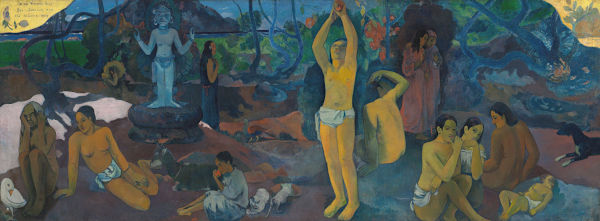
Where Do We Come From? What Are We? Where Are We Going?, 1897, o/c, 55" × 148", Boston Museum of Fine Arts
Bio-Fragment of George Liles: "I am an ekphrastic fiction writer living on Cape Cod. Earlier this year some writer friends taught me that word: Ekphrasis. Somehow I had survived half a century without knowing there was a word for writing literary pieces in reaction to pieces of visual art. For decades I had been writing stories that referenced Gauguin’s masterpiece, hanging in the Boston MFA, in which the dying artist asked: D'où venons-nous ? Que sommes-nous ? Où allons-nous ? What, indeed, are we? Two years ago, I switched to writing stories that reference the Breughel-ish masterpiece Landscape with the Fall of Icarus. I do know that WH Auden and William Carlos Williams wrote wonderful ekphrastic poems in response to that painting. But I think there’s still room for stories that describe how we go about plowing our fields while behind us the 21st century Icarus is plunging to his death. John Tucker’s meditation on Stuff is offered as foreground to the Fall of Icarus."