Curiosity ~ Lucidity ~ Humanity

The forest is pine-wood and flat. The kind with stag and pheasants, red and fat, flitting through the trees. The kind with long furrows—even scars that were once tilled by broken-backed villeins whose ancestors still step in their memory.
Poorly set tarmac at its edge breaks its careless blend with the rest of the English countryside. The tarmac narrows to a road that opens out again to surround a little concrete building.
I am fourteen, standing in one of the windows closest to the forest's border, pressing itself against its limbs.
Behind me, a little room and my great-grandmother, Gran, reclines in an armchair, the queen of this dominion. As ever, she is sharply dressed, gold jewelry, coiffed silver hair and a trouser suit—vermillion and proud. Defiantly insistent upon its existence.
Her room smells of tallow and lavender. Lavender seems to be the chosen flower of the women in my family. Not me though. At fourteen, I had rejected the soft subtlety of the flower and preferred the wild blue of the mountain iris.
The room we are in is small and an attempt at homeliness was clearly made but not quite achieved in the air tinged with the sharp sting of TCP. The walls are painted a pale yellow, perhaps once like butter but now more the faded off-white of low-fat margarine.
There is a bathroom that smells of old water tinged with metal and has tiles a little too white to be pleasant. A bright red emergency pull cord hangs from the ceiling.
As a younger child I would sometimes pull on them just to hear the siren. Now, in the moribund setting of the care home, they no longer bring the enticement of childish mischief but serve only as a reminder of mortality.
The steady ticking of a clock is the only sound that pervades through the stillness of this scene. In this relative quiet its insistence seems deafening.
The clock itself stands on my great grandmothers night stand. An old fashioned one you see in cartoons that has a little button at the top to prevent the alarm from ringing. It sits beside a faded book and a pair of reading glasses.
In my pockets I bunch my hands into fists as if to prevent its prodding tick and curl my toes deep into the thick carpet whose colour matches the walls. The curtains too, are of the same faded yellow and the glass on the window they frame is so warped the dim light they let in knits the colours of the room together to create a waxen cocoon.
This cocoon, though, is one of chthonic nature. There are no births between these walls.
Gran has given the place a softness though—from every surface hang silk scarves and the armchairs are draped in hand embroidered quilts whose musky odor add to the complex notes of age. She will not be dragged to the underworld. She will take her time—slowly, softly, as she wills.
A rosy-cheeked nurse enters and quickly reminds us that the lunch hour lasts between 12:00 and 13:00. This, we do not care for.
Perfection and years of performance chase us long-limbed out of the dining hall. But as the nurse closes the door with a soft click Gran stands and opens a drawer under her bed. Its interior is filled with chocolates—deliciously illicit, dressed in shining silver, purple and gold foil.
She takes a chocolate in her pale hands and passes it over to me with a wink. We feast on mischief and subtle daring. As we indulge I study the laminate wood dresser upon which is a row of brooches—one, a wooden iris painted a violent blue that I will later come to own. I do not wear it but I carry the memory of its indents upon my palm.
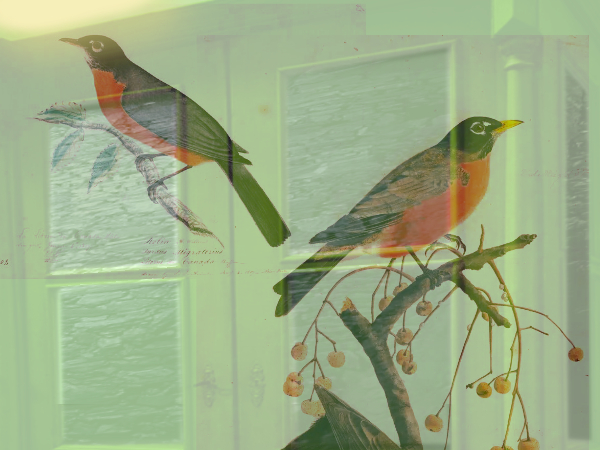
This shape of my Great-Grandmother will follow me through life, like the red robin whose image covers her walls. Black framed paintings of the little red birds who remain in the cold of the English winter well after its larger compatriots leave.
Little figurines of them, too, cover the surfaces of Gran's room. Small, birdlike and fiercely unbreakable.
At the end of her bed is a green glass cabinet. It is the latest addition to the mismatched charity shop furniture that fills the space. Inside, stands an old miners lamp of my great-grandfathers.
I think of the mines of Wales that my great-grandfather once walked through. What he must have thought about in the silence of the true-dark.
What must she have thought about, waiting for his return, in the silence of their generation, as the planes taking passengers to foreign destinations rumbled over the soft grey head of their little cottage.
I ask her if she ever thinks of Wales. If she ever misses it in the flat expanse of south-east England.
Of course she misses it, it is her home, her language, her history.
She misses Wales as it used to be, just as the stag that comes to her window each day misses the England that once was. Before even the villeins and the lords carved the land, before even, the name Christ had been uttered upon its stony shores.
When the land was free and unmolded and the stag did not have to eat from the soft, blue veined hand of a woman whose loss was forced into parallel with its own.
I ask her about the Welsh language—if she ever misses the need to speak it now she is confined to the quiet halls of this English care home.
She does not—she speaks it in the half-light and in the darkest point of the night, aloud from her hymn books and poems. It lives in the still of her vocal chords and the shadows that run through her ribs.
'Mae gen i o hyd' she tells me with a proud smile.
I still have it.
Four years later, at her funeral, I’ll whisper that phrase back to her coffin. I do not cry until my grandfather nods his final goodbye, in the centre of the church aisle, cap in hand.
Bio-Fragment: Inez Khaddi is a 20 year old woman who likes to exaggerate. When enough people are fascinated by what she has to say she calls it a story. She likes pigeons, writing poetry in secret and the mountains. She grew up in York and as a result is attracted to any man who vaguely resembles a viking.