Curiosity ~ Lucidity ~ Humanity


Did you know that once a fire is ignited, the light from the flames instantly reaches your eyes? For over 99.99% of human existence, this is what people believed, and who could blame them, as nothing in their experience would have suggested otherwise. Sound also may have seemed instantaneous, but in the case of sound, there were clues: the existence of echoes, the time lag between lightning and thunder.
The notion that sound did not travel instantly may have led some to wonder if the same could be true of light. The first person in history to have recorded this speculation was a Greek philosopher named Empedocles who lived 494-434 BC. His view that light required time to travel from point to point may have gotten things backward, however, as he believed that light streamed from the eyes, then made contact with objects beyond.
Some two millennia later in 1638, Galileo Galilei attempted to resolve the matter, working with an assistant and comparing their reaction times to lanterns uncovered at various distances. They ultimately observed no difference between lanterns uncovered nearby and lanterns three kilometers away. If light did have a finite speed, they concluded, it would have to be very fast. (At 3 km it would have taken .00001 seconds.)
The first actual measurement of light speed, c, was not made until 1676 CE when Danish astronomer Ole Romer, observing Jupiter’s moon Io, noticed that changes in the intervals between eclipses—times when Io moved behind Jupiter—varied depending on the distance between Jupiter and Earth. He reasoned that this could be explained if light was propagated at a constant speed, and he calculated that light required 22 minutes to traverse Earth’s orbit. Shortly afterward, with the tools available at the time, Dutch astronomer Christiaan Huygens combined Romer’s observations with his own and calculated the speed of light at ~220,000 kilometers per second (136,701 mph) which was 27 % lower than the value accepted today.
We got significantly closer to that value in 1879 when Albert Michelson, working with a rotating mirror, computed a value of 299,940 kilometers per second, which was within .05% of the value currently recognized as c: 299,792 kps, (186,282 mps). Even had I put those numbers in italics it would in no way have conveyed the magnitude of that velocity. A particle traveling at that speed could circle the earth seven and a half times in one second. A more graphic picture might be to imagine how the ground would appear from a plane traveling between San Francisco and New York in a single second. Now imagine the view from a plane that could cover that distance sixty-two times in the same second.
Why that speed? Why not five miles per hour faster or slower? There is no firm consensus on that question, but one thing widely agreed upon is that nature regards c as the absolute speed limit, and it does not fool around with enforcement. Here are two of the ways: 1. Particles gain mass when accelerated. If a particle were to reach c (impossible) its mass would become infinite. To increase the velocity from 99% c to 100% would require infinite energy, which would also be impossible because all the energy in the universe is finite. 2. When push comes to shove, rather than allowing a particle to violate c, nature will alter the flow of time. This was first explained to me by Lewis Ross when the two of us were still in high school. Lew began by drawing a boxcar speeding at 50% c. (recreated from memory below).
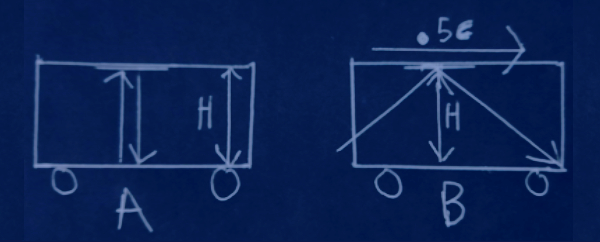
The images are of the same boxcar from different perspectives. A is from the perspective of a passenger in the boxcar, who experiences the beam of light traveling from the floor to a mirror on the ceiling then bouncing back to the floor. B is from the perspective of a stationary observer. Because the train is moving forward at .5 c, the mirror will be in a different position when struck by the light beam, and thus the arrows are longer than the arrows in A. But even though they are longer, because the height of the boxcar has not changed, and the constant c has not changed, the only thing left to bend is the flow of time. (A more complete explanation of this can be seen in the online video: YouTube)
At first, I argued with Lew, not realizing that I was also arguing with Einstein. Years after his special theory of relativity was published, the phenomenon of time dilation has been confirmed in numerous ways: clocks on planes, clocks on satellites, particles with known half- lives disintegrating more slowly when accelerated. It would have been silly to ask Lew, “How come I never noticed this,” but in point of fact, time dilation occurs at all speeds, even when one is walking. For time dilation to become measurable one has to go fast. Very fast. Even an airline pilot flying nonstop for 10 years at 500 mph would only age 88 microseconds (.0000879 sec.) less than his or her earthbound twin. At 1,000,000 mph, the time difference would only be ~ 351 seconds. At higher velocities, however, the story is entirely different. An astronaut traveling at .5 c for ten years (Earth time) would only age 8.7 years. At .8 c, the same astronaut would only age six years.
If you want to play around with such numbers, time dilation calculators can be found online at:
Could time dilation provide the means to star hopping at bargain rates in terms of time? At .3 c (not allowing for acceleration and deceleration) a trip to Proxima Centauri, the sun’s nearest neighbor, could shave off 72 days. But .3 c is not a modest ask. It would still be the equivalent of covering the distance between SFO and JFK 18 times in a single second. With current propulsion technologies, all the fuel on the planet would probably be insufficient to reach that velocity, but even if it could, it would still be necessary to include the mass of that fuel in one’s plans for lifting the rocket.
If this seems impractical, instead of sending rockets to the stars, what about electromagnetic signals? A 1.5 volt battery could launch a stream of photons at c with little fuel cost beyond what was expended in making the battery.
The ongoing SETI program has been listening for signals for years, with its dishes turned skyward. No signal has ever been detected, but patience is the name of this game. Contact would be earth-shaking, but even success would not spare us from the constraints of c. Given the probable distances, we could find ourselves in conversations where the time span between Q and A could equal the span between the Mayflower dropping anchor and today.
To paraphrase Henry II: Will no one rid us of this troublesome speed limit?
Science fiction writers do that all the time with warp drives and worm holes. A physicist—probably with multiple caveats—might offer a phenomenon known as quantum entanglement. Simply stated: a pair of particles, usually photons, are correlated in a lab. As they speed away from each other at c, each member of the pair—call them A and B—possesses a property known as polarization. At any point in their travels, a measurement of either particle would have equal chances of revealing a circular left or circular right polarization. Here’s the tricky part. The moment we measure A, we immediately know the polarization of B no matter how far apart the particles are. A could be in a Livermore lab while B is passing Pluto. The correlation occurs instantly, which in science, is not a casual word. In principle, after the establishment of c, the only thing that should ever occur instantly is the rising brow of the physicist hearing the i-word. Even Einstein was not comfortable with it, referring to the phenomenon as “spooky action at a distance.”
Does quantum entanglement mean that we have identified a natural phenomenon that violates the speed of light? Scientists don’t like to say it that way. They can only report the facts. The phenomenon has been repeated and confirmed innumerable times. No signal between A and B has ever been detected. The polarization of one instantly reveals the state of the other. And because scientists know what everyone would be thinking, they also stipulate that there is no way this could ever be used to send a message faster than c.
So, how does a particle passing Pluto know what just happened in Livermore? Physicists tell us that this is looking at it the wrong way. The information does not “travel.” Both particles, A & B, are part of the same wave function, and once polarization is collapsed at any point in the wave, it collapses everywhere, regardless of distance. The finer points of this are still being debated, which tells us that there is still more to be learned. It took ∼ 300,000 years to figure out the speed of light, so it should not surprise us if the universe still holds a few secrets.
Speed of light – history link. Galileo Galilei ibid. Empedocles link. Ole Romer link. Albert Michelson—1879 experiment The Site Where Albert Michelson Measured the Speed of Light 145 Years Ago | American Physical Society link. Quantum entanglement link
Dennis Kaplan Bio-Fragment: "I was still in high school when a classmate blew my mind with tales of what happens when particles approach light speed. I’ve been obsessed with the topic ever since. Could a Tesla one day achieve Warp Factor Six? I’m not sure I’ve resolved the matter, but be wary of claims you see in the ads."