Curiosity ~ Lucidity ~ Humanity

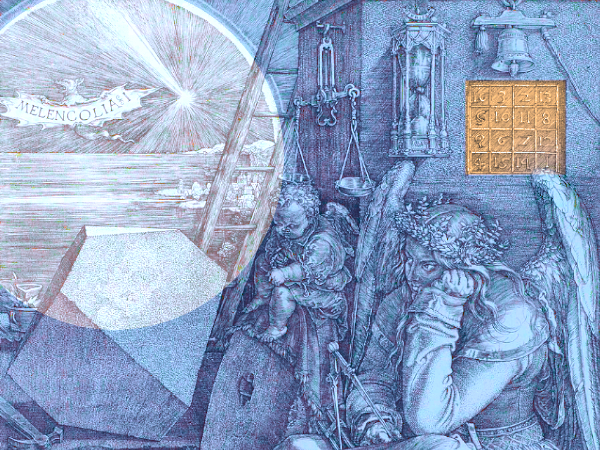
Melancolia - 1514 - by Albrecht Dürer
Poets come by melancholy
easily. Jealousy kicks hard,
its fierce generosity lingering,
demons offering no absolution.
Melancolia is constructed of a Magic Square that, among other places, appears in the Renaissance engraving "Melancholia I" by Albrecht Durer. The square is:
16 - 3 - 2 - 13
5 - 10 - 11 - 8
9 - 6 - 7 - 12
4 - 15 - 14 - 1
Each row, column, and diagonal adds up to 34. The author converted each integer to its position equivalent in the alphabet (1=a; 2=b; 3=c; and so on). Then he built a poem of four lines, each with four words, each word starting with that letter in its place. Thus the first line (16 - 3 - 2 - 13) becomes (p c b m) before becoming a line with words starting with those letters (Poets come by melancholy). The poem proceeds from this constraint.
Keelboat xebecs gravitate toward colonial
Destinations. Lately, yeomen help pilot
Quantum escapades, missions unlimited. Inevitably,
Junketeers reject astronomy’s naysayers. Voyagers,
With full sails, begin odysseys.
Ad Astra, is likewise built from a Magic Square, this time 5x5. The Magic Square is:
11 - 24 - 7 - 20 - 3
4 - 12 - 25 - 8 - 16
17 - 5 - 13 - 21 - 9
10 - 18 - 1 - 14 - 22
23 - 6 - 19 - 2 - 15
Before getting fired,
I expected another
dumb, cordial handshake.
Didn’t I believe
company ethics? “Gather
holdings and farewell.”
How could department
associates endure? In
Faith? Good bonuses?
Forgetful as hired
generations ever could
be, I departed.
Tumbling Out the Door, contemplates a low-level job from the perspective of a person who has just been laid off, is built from a 3x3 Magic Square:
2 - 7 - 6
9 - 5 - 1
4 - 3 - 8
The first of the four stanzas follows this pattern (just like the first two poems). But the second stanza is built from the Magic Square in the first stanza having been turned (clockwise) one quarter turn:
4 - 9 - 2
3 - 5 - 7
8 - 1 - 6
The pattern continues for four stanzas, each of which is also in the form of an American style haiku: the total syllable counts in the three lines are: 5 - 7 - 5.