Curiosity ~ Lucidity ~ Humanity

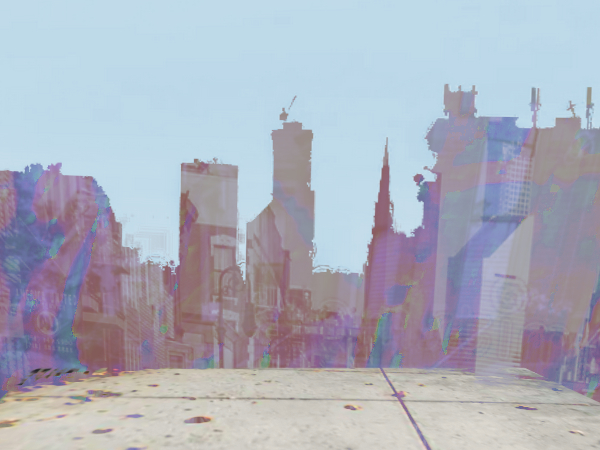
Hank and I had been awake long enough that the apartment felt borrowed. It was a three month rental north of Prospect Park, probably one block into Greenpoint, but I still told people I lived in Williamsburg.
It felt like something I was already nostalgic for.
Sleep didn’t come up.
“Cities feel like vague ideas until you live in them,” I said.
I passed Hank the small mirror with the black cat on the back.
“Totally,” he said. “Where’s the notebook? We should write that down.”
I grabbed a small notebook with pictures of babies dressed as angels on the cover.
“Wait,” I said. “We never finished talking about small towns.”
“Right,” he said. “I think small towns have a silence to them that demands you have a, like, inner means of being.”
“In every small town that I lived growing up, the nicest restaurant always had carpet.”
“Weird.”
“I hadn’t been back to North Carolina for ten years until last year.”
“How was it?” he asked.
“Awful,” I said. “Nothing had changed, which felt personal somehow.”
“What else is written in there?”
I flipped the notebook toward him.
“It says, ‘you are also dying.’”
“That’s rude,” he said.
“I think you wrote it.”
I didn’t remember writing it. I remembered agreeing with it.
Hank stood up and stretched, arms overhead, like he’d finished a shift.
“Okay,” he said. “We should eat.”
“Agreed,” I said. My body, however, did not agree with anything.
There was a Japanese place in Greenpoint Hank wanted to find. It had a famously good breakfast menu. Someone had told Hank about it years ago, which meant it might not exist.
But it had a name.
“Kingo,” he said. “Kingo.”
“Are you trying to summon it?” I asked.
“I’m memorizing it.”
The morning felt conditional as we walked. Parents already tired, dogs already disappointed. The air felt neutral, like the city hadn’t decided what kind of day it wanted to inflict on us.
We checked our phones, then we traded and checked each other’s phones. We crossed streets simply because we had the light, then forgot why we were on the other side. The traffic was loud with people who had slept. Greenpoint itself had started to seem theoretical.
Hank was convinced we were close to something.
“We’re circling it,” he said.
“I don’t think we are,” I said.
Hank stopped walking and looked around.
“Okay,” he said. “Either the place moved, or it was a myth.”
“That happens,” I said.
We stood for a moment too long. I could feel myself slowing down.
The night no longer felt infinite. The day felt like something I would be asked to justify.
“Let’s find food and then head back,” I said. “I have at least two more grams.”
It seemed like a plan.
We fell into step. Somehow, we got to Transmitter Park. I thought he was leading. He assumed I was.
We found a bench.
“Let me ask you something,” I said. “I met someone for drinks the other night.”
“How’d it go?” he asked.
“She was nice and all. But when we ordered drinks, she ordered a glass of milk.”
“Huh,” he said.
“Is that a red flag?” I asked. “A pint of whole milk.”
We started walking east, away from the river. “Fine,” Hank said. “Let’s talk about milk.”
I nodded. It seemed inevitable.
“You’re pro- or anti-?” I asked.
“I’m conflicted,” he said. “Which is where all good thinking lives.”
“Seems like an easy decision.”
“Milk is nostalgia. Milk is peril. Milk is bone propaganda. It’s also delicious. This is the problem.”
We passed a bodega. He gestured at the milk case like it was evidence.
“Look at that. Whole, two percent, oat, almond pretending to be milk, soy that has given up. Chaos.”
“Hank,” I said. “Do you drink milk?”
“Not whole milk,” he said. “I’m not a psychopath.”
We gave up entirely on food. The idea of eating had become abstract. We turned back without acknowledging it, like we’d agreed to save face for each other.
“Everyone knows the hits,” Hank said. “But no one respects the deep cuts.”
“I don’t know if I know any deep cuts,” I said.
“That’s because society failed you,” he said. “It failed me too. Wang Chung has entire albums that we’ve never heard.”
“I only know the eponymous,” I said.
“You know that song isn’t called Wang Chung,
right?” “It isn’t?”
“It’s called ‘Everybody Have Fun Tonight.’”
“Fun song.”
“Exactly,” he said. “But it’s not the point.”
Back at the apartment, the light was harsh.
Honest.
Hank put on a Wang Chung album.
“Trust me,” he said.
I lay on the couch without moving cushions. Hank stretched out on the floor, arms at his sides, staring at the ceiling.
The music played. Synths that sounded optimistic. Voices that believed something was about to happen.
I had the sudden, unwelcome thought that something already had.
I fell asleep and woke up to Hank talking, quieter now, to no one.
“Milk,” he said.
I closed my eyes. The album kept going.
Outside, someone dragged something heavy down the sidewalk.
The day went on without us.
Bio-Fragment: Jonathan Daniel Gardner is a writer. He lives in Brooklyn because he is a writer and his name is Jonathan. Since moving to the city, he has developed a complicated relationship with errands and a rich inner life about public transportation. He is a depressive optimist, which makes him an unconvincing nihilist. His interests include hesitation, restraint, and the fantasy that one good sentence might explain everything else. He pays close attention to how people talk when they’re almost saying what they mean. His writing lingers there, maybe a little too long, but on purpose.