Curiosity ~ Lucidity ~ Humanity

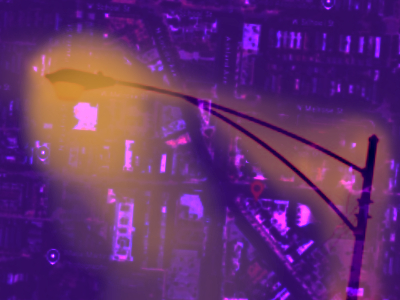
He hung a left off Roscoe, onto a deserted, derelict section of North Lincoln Avenue, briskly striding toward one of Chicago's Six Corners: Lincoln, Belmont, and Ashland Avenues. The air was crisp, the sky clear that November night. Exhaled breath turned a pale yellow under the sodium vapor street lamps while a light bracing northeast wind came off Lake Michigan, dropping the temperature into the lower forties. Welcome to Fall 1980, a month before his twenty-eighth birthday and a month before John Lennon's murder.
1980 had been brutal, given the fallout from a three-month trip to an Indian ashram and the concurrent end of a ten-year relationship. When he left Chicago, his partner collapsed with bouts of fever and colitis, for six weeks, followed by decisive action. Maura moved his belongings to his parents' townhouse. Then, she rented a small studio apartment on the corner of West Patterson and North Wolcott. What began between them in May 1970 ended a decade later.
Maura had joined forces with her man-child, a fellow first-year teenage college dropout, at the end of the turbulent 1960s. As the 1970s wound down, the counter-cultural penumbra sheltering their bond had eroded. Maura described him (metaphorically and bitterly) to others and to his face as an angel with broken wings, one whose promise had reached its expiration date.
Between the psychological jolts from the ashram experience and Maura's exit, he'd entered a "dark night of the soul"—internal territory that was, for him, as complex as it was opaque. The lyrics of Bruce Cockburn's recent songs, such as "Broken Wheel:” You and me / we are the break in the broken wheel / Bleeding wound that would not heal, and "The Rose Above the Sky:” You carry the weight of inherited sorrow / From the first day till you die, served as a soundtrack to his nightly walks past the shuttered storefronts.
On that November night, the body hosting that dark night of the soul energetically strode past the North Lincoln Avenue glass storefront of Borg Jewelers and the hot dog and hamburger joint, dub-L-dog, across the street from the Wieboldt department store and O’Connor Shoes, less than a hundred feet away from the tri-avenue nexus.
Six Corners, an intersection of those three broad arterial streets, was saturated by sodium vapor light from a grove of curved street lamps. The north-south Ashland Avenue corridor stretched empty—six vacant lanes forming an ad hoc stage beneath the phosphorescent glow. The sole sounds came from the irregular buzzing of street lamps, a murmuring electric chorus punctuating the stillness.
And then—
A late 1950s vehicle, probably a cream-puff 1958 Chrysler Saratoga, materialized out-of-the-blinding nothingness, an enameled apparition running a red light and headed north on Ashland Avenue. The improbable vehicle sported an aqua body with a white chevron that expanded from a narrow point from the front and central edge of the driver's door, a widening maw over the remaining length of the vehicle, terminating where the rear fins met the bulbous tail lights. The AquaMobile had all the requisite period design accents: Chrome bumpers, trim, and a white top glinting under the streetlights.
As the apparition barreled past Belmont Avenue, two gunshots ruptured the silence of the night. He ducked into a store vestibule, pulse quickening. Concealed, he witnessed this: The antique sedan screeched to a stop. The driver's side backseat door opened wide, and a body thumped onto the median on North Ashland Avenue. Then the bright whitewall tires squealed, burning rubber against cold asphalt, and the AquaMobile sped away.
Forty-five seconds later, a seemingly infinite time suspended between heartbeats, an olive truck, with a Red Cross insignia pasted against a white background on its otherwise olive canvas side, tires screeching, lurched up to the freshly chucked out body, full stop. Two men in camouflage uniforms and combat boots sprung out the back of the truck onto the Ashland Avenue median, heaving the body into the cargo bed and jumping back in. Then, the olive rig skoodled away.
In the still, chill air that remained, he stood dumbfounded, alone. Everything was as it had been two minutes earlier. The indifferent roads were bereft of traffic once again.
Stunned to the point of shock, another shock in a year of shocks just behind and still ahead, he briskly walked back to his crucible of restless sorrow. Within the immediate shock, however, he had questions about what he had just seen, as dream-like, opaque, mysterious, and unanswerable as the events and questions in his iterative dreams, questions about his life, questions that then yielded no structure, no direction, and no answers.
Years later, he understood that midnight event as a distillation of that transitional period, the improbable scene mirroring the ongoing demolition of his understanding of Self and World, the etching of an indelible moment where liminal, parallel spaces between fact and dream collided.
Bio-Fragment of Dion Dennis: The younger son of a Holocaust survivor, Dion Dennis writes memoir pieces spanning more than six decades of American life. He has been a high school dropout, a Fuller Brush salesman, an institutional janitor, an inveterate traveler, a middle manager and, for a while, a lost soul. Eventually, he earned a PhD. As a memoirist, the focus is on the intersection between personal experience and social and psychological dynamics. His approach emphasizes reflection, analysis and ambiguity, rather than performative vulnerability, therapeutic theater and a redemptive catharsis.