Curiosity ~ Lucidity ~ Humanity

Kann ya makan, fi gadim i-zaman—there was a time in the olden days... That’s the way stories used to start in the Middle East. When children heard that phrase, they stopped cavorting and settled at the feet of the storyteller while the grownups drew up chairs one row back. These stories were meant for old and young alike with wisdom that satisfied at every level.
The best story tellers were the elderly, a grandfather or grandmother, but it could be a mother or father or even a travelling storyteller. That got me thinking about how effective storytelling is at passing down wisdom from one generation to the next—so much better than cross words or lectures on values. The first hurtle of course is for audiences to believe in stories told by the old—not so easy in the internet age where the young dominate.
How did cultures do it? In the golden years before conflicts focused people so much on their own tragedies, storytelling was enjoyed in many forms. There were Hakawatis (storytellers) who made a living going from café to café relating episodes from romantic fables like the one about the star-crossed lovers Antar and Abla. For the Hakawatis, keeping the audience mesmerized was every bit as important as the story itself. Just when things got exciting, the Hakawati would move on to another café, and the audience had to await another visit for his next installment.
Another never-ending story started when circles of poets gathered on summer evenings in Syria. A respected leader would begin with a single opening line, before the story moved to the next person and the next with each adding a line—usually in poetry—until late into the night. In Pakistan, stories often were sung in balad form, with every song seemingly a riff on unrequited love under a chinar tree, that after twists and turns, always ended badly. One evening just to see what would happen, I created a story that ended happily under the chinar tree and though it didn’t sit well with my Pakistani colleagues, they agreed to put it to music.
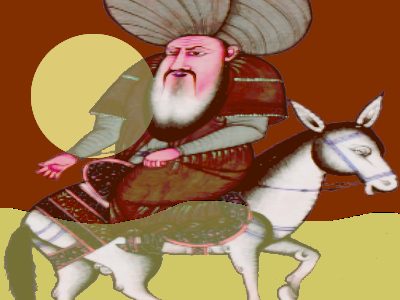
If the conversation lags anywhere in the Middle East, it can always be revived by starting a Hoja story. Hoja, Geha, Goha, however he is named, is the wise fool who mostly prevails over his opponents while teaching them some truism. But sometimes the stories point to lessons to learn from life’s never-ending challenges. In one tale, Hoja leads his donkey to town. Someone chastises him for walking when he could ride, then riding while his poor son walks, and then overheating the donkey when they both ride. Finally, Hoja grumbles, “No matter what you do, you will be criticized,” and picks up his donkey and carries him home. Such stories are not meant to lead toward a single climax that resolves everything. Rather they mirror the ups and downs of life itself, very much in the way decorative tiles in mosques repeat themselves again and again as far as the eye can see.
Among my contemporaries in the Middle East, just about any prolonged conversation contained endearments, parables, and universal truths in pre-packaged form. I remember Lebanese Mona, telling me how her mother answered the question of which was her favorite child, with “The far one till he returns, the sick one till he recovers, the young one till he grows older”—a wonderful expression of enduring love for them all, while still suggesting circumstances when one child might be favored over another.
The wonderful thing about sayings is that you don’t need to search far to find one that expresses just about anything you want to say--even contradictory themes. The classic Arab saying about family loyalties says: “I against my brother, my brother and I against our cousins, and my brother, my cousins and I against the world” can be contradicted by other truisms: “Better the neighbor than the far away relative” or “Chose the neighbor before the house.”
A warning I should have taken seriously was the parable about not letting the camel warm his nose under the tent. When his master wakes the next morning, the whole camel is sleeping comfortably inside. In my case, a grandson of an acquaintance asked to use an empty bedroom in my summer house for a week to attend an event in town. Before I knew it, five members of his family were enjoying my bedrooms for periods extending over 3 weeks! I should never have let the camel put his nose under my tent. But then if I hadn’t, I would have violated all the proverbs about generosity and hospitality.
Sayings are of course not unique to other cultures. My Quaker grandmother used to wake me up in the morning gently with “Andrea, the early bird catches the worm” or if I procrastinated too long “A stitch in time saves nine”. Or if I craved something I couldn’t get, she might warn that “A bird in the hand is worth two in the bush.” These were all inoffensive ways of conveying messages to me with a staying power far greater than calling me lazy or greedy.
We might do well to rethink this staying power of such wisdoms, as we seek to leave a legacy with future generations. What better reason for these parables, wise saying and stories than to gently offer advice that is clear and memorable but indirect and spoken in a way that sounds more like a universal truth than a scolding.