Curiosity ~ Lucidity ~ Humanity

Note to readers: This essay contains discussion of mental illness.
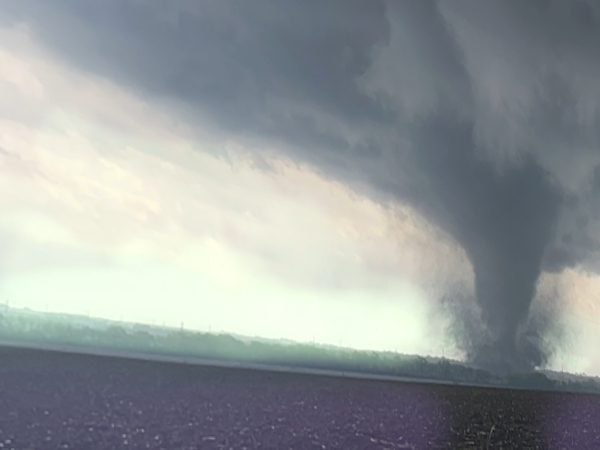
Midnight. The harrowing, brutal thunderstorm ends as abruptly as it began. The power goes out as an eerie quiet falls over our neighborhood. The TV snapped into blackness and the darkness felt total, alive. Outside, in this unnatural quiet, I could hear branches scraping the siding. Somewhere a transformer blew—one hard pop—and then even that died. Minutes later I sit bolt upright, hearing what seemed like a freight train roaring toward the house. I’d been in earthquakes and hurricanes, but never a tornado—but, in that split second when you just know something even though you’d never experienced it before, I knew that sound meant a tornado was coming—and it was coming fast.
Folklore says if you spot a green-tinted sky, take it as a signal that a tornado could be coming. But meteorology isn’t an exact science. Neither a green sky nor thick dark clouds guarantee the formation of a tornado. It’s only when a tornado detection system discerns a storm on the ground that the warning is sounded. A tornado often sweeps into a neighborhood, its power raw and untamed, shattering lives and splintering dreams. But nothing warns you when a storm is brewing inside your own home.
The tornado advanced on our small piece of North Carolina in southeastern Brunswick County late in the evening of Feb. 15, 2021, and, in its wake it left severe damage to the neighborhood. Later we’d learn that the storm carved a damage swath up to 275 yards wide.
In 2003, my husband of 20 years, the father of my two daughters, died at home after suffering severe cardiac arrest. My daughter, my mother and I had just begun Sunday breakfast when he rushed into the kitchen out of breath and white as a ghost.
“Ellen, I don’t feel right,” he managed to utter before collapsing into the club chair in the family room. The next thing I remember was screaming into the telephone at the 911 dispatcher, “When are they coming?”
My daughter and I watch at a distance, our elbows on the kitchen island as the EMTs pound across the kitchen thrusting the heavy furniture across the hardwood floor. The room is a blur as the sheriff arrives and pulls me aside suggesting I take my 14- year-old daughter upstairs. My elderly mother weeps in her bedroom.
In the aftermath of our loss, my daughter, now 37, struggled with severe mental health challenges including clinical depression, anxiety and extreme mood swings, suicidal ideation and emotional dysregulation. These symptoms manifested themselves in emotional outbursts, long periods of inertia and lack of self-care, and reckless behavior that included sexual experimentation and drug use.
There were the sleepless nights I spent when I had no idea where she was or who she was with, my endless texts going unanswered. Back then, when I tell my therapist about this, she reminds me, in a pointed and terrifying response, that texting my daughter is not keeping her alive. There were the emails I found where she was arranging photoshoots with strange people in the city—meetings that involved bondage and nudity. Only later did I learn that sexualization is common among certain mental illnesses including bipolar disorder and borderline personality disorder. I find it hard to maintain a grip on what’s become my new reality where each day brings a challenge and new, disturbing behaviors.
Several years after her father’s death we were blindsided by her first psychotic break. I had no idea at the time what a psychotic break was. Although I knew her emotional state was fragile, my daughter said she was ready to be on her own and we helped her move into a small basement apartment in a funky area of Baltimore, a neighborhood replete with hipster coffeeshops and overpriced organic grocery stores. It sounded great, but soon after on a bright summer morning, her therapist was frantic—texting me—raising an alarm. We should head to Baltimore. My daughter was suicidal.
Her stepfather, whom I married nine years after my first husband’s death, and I found her huddled on a bare mattress in the corner of the bedroom crying, incoherent and adamant that she was not leaving the apartment. Doing only what I knew I could at that moment, I began washing the dishes and stacking them neatly in the drainer. Sweeping the floor, I thought, was an act of help I could accomplish that would somehow make things better when she stopped crying and saw how I’d put everything to order. I realize this was my M.O. over the years, fix the outward, the seen, and hope that that gesture is enough to instill the will to fix the unseen. I didn’t know enough about how to handle a situation like this. Why did I hesitate to call 911? I don’t know. We drove home, me crying for the hour ride, leaving her alone in that dark basement. Later that evening, her boyfriend—a sweet guy way out of his depth in dealing with her blossoming illness—returned her to us like an unmanageable adopted stray. It was 4th of July weekend, and I can still see the two of them, arms around each other in our driveway, silhouetted by fireworks exploding over the neighborhood. I wished she could stay like that forever, safe in someone’s sheltering arms.
I grew up in a world where CANCER was uttered in whispers by old ladies on stoops so that the children couldn’t hear, or maybe it was just because saying it out loud made it real or more terrifying. Back then, struggles with mental health were often hidden away, too, much like the sufferers were, as families tried to put this messiness out of their minds. My mother’s older sister suffered with schizophrenia. When I was a child, she’d often take to her bed for weeks— sometimes months—at a time, not leaving the tiny apartment on Staten Island she shared with her husband. A bit secretive and, I assume, not willing to face stigma or criticism, my uncle aided and abetted this isolation, with actions that included sending my mother and other aunts away, as well as leaving the door unanswered when the minister or well-meaning church friends called with food or prayer or both. Sometimes, when Aunt Harriett was “feeling better,” my parents and I visited. I remember a sweet, if a little unfocused, lady with a lilting, sing-song-y voice and clear, pale skin; attributes which, combined with her pleasant, powdery, soft-edged scent, gave me the impression that she was ephemeral and could fly away at any minute, like the fragile seed heads on a dandelion bloom. My WASP-ish elderly aunts always seemed so much more old-fashioned than the women I encountered in my neighborhood—brassy Irishwomen, stern German shopkeepers, overbearing, but warm and loving, Italian mothers of my friends. I never saw the aunts dressed in anything other than what we once called “day dresses,” sensible shoes and gloves. On one occasion, when Aunt Harriett took it upon herself to board the Staten Island Ferry and the subway to visit us in Brooklyn, she offered to walk with me to the corner store. She entered the grocery with poise, carrying herself as if she were walking to a table at The Russian Tea Room. I held back, following her in my cotton shorts, Keds and t-shirt, knowing that somehow, she was an anomaly in this place with its crooked wooden floors, shelves haphazardly laden with boxes of Ronzoni and Corn Flakes and a counter that served as packing, slicing and wrapping space, all sharing space with boxes of penny candies (my main reason for getting her to walk with me) like jell rings, Bazooka gum and licorice twists. I tried not to worry about what the reaction would be if I’d run into any of my friends.
“I’m Ellen’s aunt Harriett,” she announced loudly, surprising the frumpy wife of the owner who was perched on a stool next to the register, smoking a cigarette and studying a copy of pari-mutuel results in the Daily News. Too young to be embarrassed by my obviously eccentric companion, I was proud to have such an elegant aunt.
When I visited my aunt and uncle’s apartment, I often paused in their kitchen and stole a glimpse through an archway into the darkened bedroom, obsessed with the rumpled bedclothes (my mother never left the beds unmade!) wondering, is this where she goes when my mother tells my father that “Harriett’s back in bed again?” I often asked my mother what caused Aunt Harriett’s behavior. Why was she hiding in her bed? Was there a catalyst? Always the answer was, we don’t know.
Growing up, I understood nothing about my aunt’s illness beyond whispered words between my mother and her sisters. In the 1950s and ’60s, mental health wasn’t something doctors discussed or families understood. There were none of the medications and treatments as we know them today, no coordinated treatment plans, no therapists offering language for trauma. People like my aunt were simply sent away, shuttered out of view so their suffering wouldn’t disrupt the delicate image of a functioning family.
My mother and her sisters were unable to cope with Harriett’s changing moods and unnatural behaviors. One week she’d be sweet and dreamy, floating barely-there through her days, and the next she would plunge into immovable despair, refusing to leave her bed. Back then, loved ones could commit someone with just a signature and a nod from a doctor. The threat of being loaded into an ambulance in the middle of the night and ferried to Bellevue (in my mind I pictured something akin to “The Snake Pit”) or sent to an institution like Pilgrim State or South Oaks hovered over families, including ours.
Sometimes Harriett would call our house late at night, waking us all. She’d plead with my mother to bring me to the phone where she’d pepper me with questions I was not yet old enough to understand. Once she asked, “Ellen-Anne, do you know what rape is?” The question terrified me. I was too young to understand the word, but I could hear something frantic in her voice. As an adult I’d wonder whether her mind fixated on sexual fears she couldn’t name.
My daughter’s mental illness would not be diagnosed for years. Instead, it unfurled quietly, like a storm system forming far out at sea—small pressures here and there, the occasional unpredictable gust. Mood swings we chalked up to adolescence. A darkness behind her eyes we told ourselves was teenage melodrama. Only later would I understand that she was already living inside something I could not see, something gathering strength.
An anxious child, my daughter often balked at things both simple and major. When we all wanted to head to a casual weeknight dinner at the Outback or Logan’s Roadhouse, she insisted on staying at home. After stalling for months about shopping for a dress (and finally making do with her sister’s hand-me-down) she refused to get ready for her First Holy Communion Mass until we were within minutes of being late to join her class at the church. Choosing a graduation picture from her proofs was like asking her to sacrifice a beloved pet. I finally chose for her without any input. Sending her with her sister for a couple of weeks to her grandmother’s house on Long Island often resulted in my mother-in-law becoming frustrated by what she saw as intentional contrary behavior designed to irritate and anger her. Her father and I didn’t consider these episodes a bellwether of something more serious. “She’d mature out of it,” we’d say.
When she returned to school after her dad’s death, I noticed changes. Where previously she had been engaged and inspired, she was now aloof and disoriented—a puzzle and, as her psyche began to crumble, the various pieces piled up and appeared in all the wrong places. Early on, I explored physical reasons for what she was experiencing, thinking there may have been a medical condition we were unaware of. I was uninformed and, I think, reluctant to name it: mental illness. I was certain what was happening was tied to the grief our family was still experiencing after my husband’s death.
I soon made urging her into treatment and starting a long slog searching for answers my life’s work, to the detriment of supporting my older daughter in her own grief journey.
As our family is in the throes of what seem like wave of crisis after crisis, I’ll recall my naivete. The calls to 911—the ones I thought I’d never need to make—and the resulting police visits to our home—multiplied as our fears that she’d harm herself grew more urgent. There were what seemed like thousands of doctor appointments, therapy sessions—attended and missed—late-night ER visits and the prescription roulette of modern psychiatry. Each week I found myself on an endless loop of telephone calls to providers, treatment centers, psychiatric hospitals and insurance providers.
The tornado entered our community where it became exceptionally powerful in its quest to pick off homes to damage or destroy. Many homes were obliterated including one, across the golf course from the back of our house (this house, a jumbled mess of wood, twisted rebar, cement and flapping siding that I’d have to look at every time I peered out my bedroom window, traumatized me anew nearly every day for over a year after the storm, until it was finally bulldozed away). We’d learn that two of our neighbors died when two homes at the end of our cul-de-sac had pancaked: in a Wizard of Oz moment, one of the houses rose from its foundation and, in a matter of seconds, dropped squarely on the other.
Weather researchers have attempted to drop probes in the path of tornadoes or to inject them with chemicals or other material hoping to study them from the inside out. Not many of these efforts have proved successful or returned any significant data. Much like neuroscientists are equally baffled by storms of the mind, it seems scientists can’t quite decode the physics of tornadoes. In 2023, the US National Institutes of Health (NIH) poured $1.25 billion into research studying how mental illness manifests in the brain. Despite having more access to medication in the US than ever, in 2022, a record high 49,500 people died by suicide. This rate was the highest since 1941. It seems like we’re not any closer to understanding the challenges of diagnosing and treating mental health than we were 50 years ago.
After my aunt’s husband died, my mother and her older sister finally had the legal authority—and perhaps the emotional permission—to move Harriett into an assisted living facility near our aunt’s home in New York. For the first time in a long time, she received regular meals, medication on schedule, and care from people who understood her limitations. Surprisingly, she seemed to thrive. Later, with my other aunt aging and unable to monitor Harriett’s care at the New York facility, it made more sense to move her nearer to my mother and her other sister who had both retired to Texas. She remained pretty stable. While she was still the same dreamy and confused Aunt Harriett, the violent episodes stopped. I guess structure held where love and concern alone had not been enough.
She lived well into her eighties, her illness no longer a daily crisis but a softened, managed part of her existence. I sometimes think about how different her life—and the lives of her husband and sisters—would have been if everyone would have been more open and educated about mental illness.
Why was our family singled out for this journey into the mental illness abyss? I don’t think I’ll ever know. When a tornado strikes, why do entire homes lift off their foundations while houses a few blocks away remain untouched? How is one to know if there isn’t a valid predictor?
The mind is capricious. It doesn’t allow itself to be easily analyzed or categorized. My daughter has made some progress processing the trauma of what her brain tells her is her father’s abandonment. Although it often seems like this progress is much like the adage “one step forward, two steps back.” Yet, I hold out hope that around the corner may be the promise of a new treatment that will release the grip the disease holds on our family.
As the wind roared around us and the house moaned, my husband and I stumbled in the pitch dark over the bedclothes, trying to avoid shards of glass from a shattered bedroom window. As I sprinted to the laundry room (the only room in our home without any windows), I grab what I think is my phone but, in a comical turn of events, realize it’s the television remote. My husband, who needed to navigate around the bed to exit the room, takes longer. The wind is sucking all the air out of the narrow hallway to the garage as I scream, “Come on,” to my husband. We push the door closed against a wind that pulses with an unfathomable strength and cling to each other for what seems like hours, listening to glass breaking and wood cracking beyond the laundry room door.
“Are we going to die?” I croak to my remarkably calm husband. “Not tonight,” he says with surprising confidence.
Three of my neighbors died that night, but my husband and I were spared. It took years for our neighborhood to recover physically and aesthetically. In many ways, many of us are still recovering emotionally.
Even when no one warns you, the mysteries of the human psyche—the storms that run in families—are unpredictable and unstoppable, defying our efforts to control or foresee them. Even when you tell yourself you’ve built a life sturdier than the one you came from.
My aunt lived the rest of her life in those fluctuations; and I think she may have charted her internal storms the way farmers track the sky. I also hope that my daughter, too, is learning to forecast her own fragile climate.
And I—mother, daughter, niece—find myself standing in a debris field between them, listening for freight trains and sirens, scanning the horizon, knowing that the storms that shape us never fully pass. They only teach us how to live inside the unpredictable.
In our dark house after the storm, after we’ve connected with our neighbors and viewed in the darkness the two homes in ruins at the foot of our street (only in daylight would we see how devastating it really was), after we’d all wandered around aimlessly, still in shock, I lay awake for a long time, watching as flashlights throw eerie shadows of emergency personal combing the backyards looking for people. I scroll social media where I find groups of storm chasers exchanging data about our tornado. For hours, I hit refresh over and over to see what they’ve learned.
Much later, I’ll recall the struggles of my aunt whose own mind had been lifted from its moorings long before I was born; and a family that used a vocabulary of euphemisms: episodes, nervous spells, troubles, realizing they are the same struggles my daughter seems to have inherited and now battles using 21st century therapies.
Sometimes in the dead hours between midnight and dawn, when it feels like everyone else is asleep, the quiet blanketing even common small animal sounds, or the traffic on the interstate, my husband sleeps beside me as I lay awake listening to the house breathe. A drip in the gutter. The hum of the refrigerator, the ice dropping into the basket. My own heartbeat, too loud. My husband sometimes laughs at my sudden angst if a sudden thunderstorm erupts or my daughter goes silent unexpectedly. He tells me I worry too much. I don’t have panic attacks very often now, but when I do I remember them much like the strange quiet, after the tornado passed, when nothing is known, but something terrible is suspected. I recall the air still thick with the storm’s violence, its energy lingering the way my panic attacks do long after my body technically calms down. I remind myself that I still need to keep watch.
Bio-Fragment: Originally from New York City, Ellen Acconcia is a recovering marketing/PR professional who lives and writes from her home in coastal North Carolina. She is an avid reader, an essayist and freelance writer, and a novice quilter who needs to practice her straight stitching. Her work explores memory, parenting, older adults and mental illness.